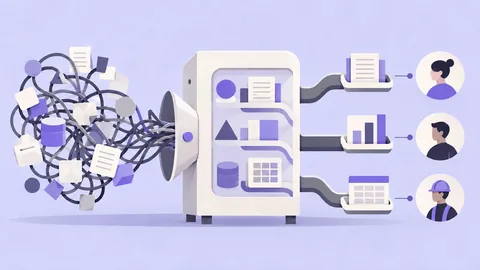
The practical answer
Show progress, dependencies, saved state, and the next valid action. Support interruption and resumption, make validation understandable, and explain what must be completed before a workflow can advance.
Key takeaways
- Workflow complexity: workflow complexity should be defined early enough to influence architecture, not added during visual polish.
- Role-based access: Treat role-based access as a testable product decision with an owner and a success signal.
- Data density: Document data density explicitly so design and engineering do not resolve it differently.
- Expert efficiency: Use realistic content to validate expert efficiency; placeholder data can hide important failures.
- Auditability: Connect auditability to user behavior and business risk rather than treating it as a style preference.
The core principles
1. Workflow complexity
Prioritize frequent and costly actions. Test with realistic content and edge cases; placeholder data hides many of the problems that appear in production. A useful validation signal is error and rework rate, but the number should be read alongside qualitative evidence so the team understands why behavior changed. One recurring failure mode is optimizing one screen while breaking the workflow.
2. Role-based access
Prototype dense states with realistic production data. A useful validation signal is support ticket volume, but the number should be read alongside qualitative evidence so the team understands why behavior changed. One recurring failure mode is designing tables with dummy data.
3. Data density
A stronger decision is to prioritize frequent and costly actions. Treat the first design as a hypothesis and keep a visible trail from evidence to decision. A useful validation signal is workflow throughput, but the number should be read alongside qualitative evidence so the team understands why behavior changed.
4. Expert efficiency
For a product team, the practical implication is to prototype dense states with realistic production data. A useful validation signal is training time, but the number should be read alongside qualitative evidence so the team understands why behavior changed.
5. Auditability
When the stakes are higher, teams should use progressive disclosure for secondary detail. One recurring failure mode is hiding essential context to make screens look clean.
6. Bulk actions
For a product team, the practical implication is to map end-to-end workflows before screens.
7. Exceptions
When the stakes are higher, teams should design for exceptions, not just the happy path. One recurring failure mode is ignoring permissions and edge cases.
A practical framework you can use
A useful framework for UX for Long and Complex Workflows should help a team move from an ambiguous problem to a testable product decision. The sequence below is intentionally lightweight: it can fit a focused audit, a discovery sprint, or a larger redesign. Do not treat the steps as a rigid waterfall. Research can change scope, testing can reveal a missing requirement, and production data can force a team to revisit the initial diagnosis.
Step 1: Separate novice guidance from expert shortcuts. Use real constraints, representative content, and the closest available production data. Define a baseline for training time when possible, or at least a clear qualitative success criterion when quantitative measurement is not yet available. Review the step with design, product, engineering, and the people who understand the operational edge cases. Record what changed, what evidence supports the change, and what remains uncertain; this makes later iteration faster and reduces design-by-opinion.
Step 2: Prototype dense states with realistic production data. Define a baseline for adoption of high-value features when possible, or at least a clear qualitative success criterion when quantitative measurement is not yet available.
Step 3: Prioritize frequent and costly actions. Define a baseline for workflow throughput when possible, or at least a clear qualitative success criterion when quantitative measurement is not yet available.
Step 4: Map end-to-end workflows before screens.
Step 5: Design for exceptions, not just the happy path. Define a baseline for task completion time when possible, or at least a clear qualitative success criterion when quantitative measurement is not yet available.
Step 6: Use progressive disclosure for secondary detail.
Working on a real product? If you want an expert review of how these principles apply to your product, contact Osama Ali or send a WhatsApp message. I work across UX research, product design, AI/agentic UX, enterprise products, eCommerce, design systems, and Arabic/RTL experiences.
MENA, Arabic, and bilingual considerations
Even when UX for Long and Complex Workflows is not specifically an Arabic UX topic, regional context can change the design. MENA is not one homogeneous market, so a Saudi product, an Egyptian consumer service, and a UAE B2B platform should not inherit the same assumptions by default. For UX for Long and Complex Workflows, separate universal product logic from locale, language, regulation, payment, identity, content, or behavior decisions.
Regional consideration — Enterprise products may need bilingual roles and terminology. Convert this into a concrete design or research question rather than leaving it as a general cultural statement. For UX for Long and Complex Workflows, ask which workflow, label, component, policy, or metric could change because of this constraint. Then validate it with the market and user segment you actually serve. This is more reliable than building a generic 'MENA persona' and treating it as evidence.
Regional consideration — Procurement and approval workflows differ by organization.
Regional consideration — Arabic dense-data layouts need dedicated testing.
Regional consideration — Regional business processes should be mapped rather than assumed.
Regional consideration — Legacy integration constraints often shape the experience.
Regional consideration — Training and change management can be as important as interface polish.
How to measure whether the design is working
Measurement for UX for Long and Complex Workflows should match the user outcome and the business risk. With UX for Long and Complex Workflows, one number rarely tells the whole story: a shorter task can still be confusing, a higher conversion rate can hide regret, and lower support volume can mean users abandoned the task. Use a small metric set that combines behavior, quality, and operational impact.
Task completion time: define the event or observation precisely, segment it where relevant, compare it with a baseline, and pair it with qualitative evidence before drawing a conclusion.
Error and rework rate: define the event or observation precisely, segment it where relevant, compare it with a baseline, and pair it with qualitative evidence before drawing a conclusion.
Support ticket volume: define the event or observation precisely, segment it where relevant, compare it with a baseline, and pair it with qualitative evidence before drawing a conclusion.
Training time: define the event or observation precisely, segment it where relevant, compare it with a baseline, and pair it with qualitative evidence before drawing a conclusion.
Workflow throughput: define the event or observation precisely, segment it where relevant, compare it with a baseline, and pair it with qualitative evidence before drawing a conclusion.
Adoption of high-value features: define the event or observation precisely, segment it where relevant, compare it with a baseline, and pair it with qualitative evidence before drawing a conclusion.
Before launching a change to UX for Long and Complex Workflows, write the expected direction of change and what evidence would make the team reject its own hypothesis. After launch, review UX for Long and Complex Workflows by meaningful segments such as language, market, device, role, new versus returning user, or traffic source when those segments are relevant. The purpose of measurement is not to prove that design was right; it is to learn whether the product now supports the intended behavior with less friction, error, or uncertainty.
Common mistakes - and what to do instead
Mistake 1: Copying consumer-app minimalism into expert tools. This usually happens when a team optimizes the visible interface before understanding the underlying decision or workflow. In UX for Long and Complex Workflows, the safer alternative is to state the assumption explicitly, connect it to a user need or constraint, and choose a test that can challenge the assumption. If the team cannot explain what evidence would change its mind, the design decision is probably being treated as preference rather than product reasoning. Document the resolution inside the Enterprise UX system so the same debate does not restart in every sprint.
Mistake 2: Hiding essential context to make screens look clean.
Mistake 3: Optimizing one screen while breaking the workflow.
Mistake 4: Ignoring permissions and edge cases.
Mistake 5: Designing tables with dummy data.
Mistake 6: Measuring only satisfaction rather than productivity.
Implementation checklist
Define the primary user outcome for UX for Long and Complex Workflows.
Identify the user segments, roles, languages, and markets that materially change UX for Long and Complex Workflows.
Map the end-to-end workflow before optimizing an isolated screen.
Use realistic content, data, errors, and edge cases in prototypes.
Record assumptions separately from known facts.
Test the highest-risk interaction before polishing low-risk details.
Include accessibility and recovery requirements in the definition of done.
Instrument the behaviors needed to judge the outcome.
Review results by relevant segments rather than relying only on an overall average.
Document decisions and exceptions so the product can scale consistently.